Editor’s Notes, No. 01
Editor's Notes - Issue 1
This first issue starts off strong with Murphy quoting Tillie Olsen! For as much as this issue is an example of building a plane while in the air, it’s remarkable how many things that became hallmarks of the newsletter are present: the banjo/venue symbol and Casey’s Ratifications symbol stand out and even though they would change names over time, the Spotlight on, Change of Life, and Wiblets (letters from readers) columns are first seen here. This is also the first appearance of both Nancy Pate and Casey Henry’s columns which would be nearly ubiquitous throughout the rest of the publication. Speaking of, I love reading the colum from a teenage Casey. These next few Casey columns perfectly capture the excitement and angst that bluegrass teenagers still feel to this day.
The feature on Louisa is what gave me the idea to start this project in the first place. Towards the end of the column, Louisa makes a bold prediction that their will be a separate “Women’s Bluegrass Hall of Fame” in 15 years time. The first time I read these newsletters was a little more than 25 years after those comments and it was interesting to me to read that with the gift of hindsight. At the time of that interview there were no women in the bluegrass Hall of Fame (until the Carter Family’s induction in 2001), and the only woman to win an instrumentalist award was Alison Brown who was named Banjo Player of the Year in 1991. When Louisa says “women need to get special recognition where there's been special silence,” she's participating in an exercise we see throughout the publication of trying to imagine what a better world for women would look like.
Additionally, the tone during the discussion about younger women distancing themselves from all-female bands was interesting to me. I sympathize with the feeling of frustration in seeing a younger generation ignorant to the circumstances and sacrifices that afforded them the opportunity to be so selective. That conversation also mirrored some discourse I had seen online at the time between older women in the community who were struggling with the progress of social values outpacing their own private values and feeling written off as (lowercase "c") conservative because of it. This is a tale as old as time in progressive politics but the juxtaposition of these conversations happening in bluegrass 30 years apart was very intriguing.
There are many things in this newsletter that are extremely “of the time” (like the frequent use of the word “estrogen” which had a sharp decline in popular culture after the turn of the century) and this kind of “seperate but equal” second wave feminism is a frequent example. What’s really great to see as you read through the issues though, is that not only can you see Murphy’s views and opinions grow as she integrates the stories of the many women she interviews with stories and circumstances different from her own but also that the newsletter becomes a sort of open forum for these different opinions. This allows the readers to also broaden their perspectives while giving a safe space to question their own perceptions of what the role of women in society is or could be.
I also love how these more esoteric theoretical ideas are grounded by Murphy’s parallel pursuit of rock solid DATA lol. Murphy introduces the Database which we never see much more of beyond some numbers. The combination of mailing out questionarres and personally going through every issue of Bluegrass Unlimited to find any reference to female musicians is a type of obsession I have to admire. Murphy states that it encompasses both professional and "semi-proffesional" musicians and in a future issue clarifies by drawing the line at “no students” which I find interesting but one does have to draw that line somewhere and it’s unenviable in the miasma of what defines a “proffesional” bluegrass musician. At the time of writing I haven’t asked Murphy if she still has this record or whatever came of it other than being a silver bullet anytime someone said there weren’t enough/many women in bluegrass.
Speaking of databases, this was a fun issue to fill out the archive reference database for. We have lots of names and a full list of all-women bands listed on the back page. Many of these bands were regional and either never recorded or released music on a small independent label that never made it online. Band names like Local Tomatoes are all but unsearchable. I did have some luck tracking down a few of them though and in addition to their place in the database I wanted to share some of what I found here and also put out a general call for any info anyone reading this might have about these bands. You can contact me at [info@womeninbluegrassarchive.org].
First, here’s the list in full:
Muscogee River Girls, Florida
Ribbons & Straw, Nevada
Bar Belles, California
Mother-of-Pearl, Nashville
Witch Hazel, D.C.
Local Tomatoes, D.C.
Bushwhackers, Nashville
Dixie Reign, Virginia
Lonesome Doves, Washington State
Any Old Time String Band, California
Out of the Blue, Colorado
Ladies of Bluegrass, Georgia
Sassygrass, New England
Valley Dolls, Virginia
Bluegrass Liberation, North Carolina
New Coon Creek Girls, Tennessee
Petticoat Junction, Tennessee
Dixie Chicks, Texas
Ranch Romance, Seattle
Wildwood Girls, Tennessee
All Girl Boys, California
Buffalo Gals, New York
Good ol’ Persons, California
Feminine Grass
Sweet Dixie
Cherokee Rose, North Carolina
Ladies Fancy
Sugar in the Gourd
Happy Hollow String Band, North Carolina
Mountain Lace
Sidesaddle, California
Some of these bands I was already aware of but had trouble finding any digitized records of. The Bar Belles were a kind of informal band that would play at Paul’s Saloon in San Francisco that featured Laurie Lewis, Kathy Kallick, and Kathy Barwick. I wasn’t able to find any pictures or video of them online.
Similarly, I know about Cherokee Rose from talking to people like Louisa Branscomb and Missy Raines.
The Bushwhackers are infamous in Nashville bluegrass history but I wasn’t able to find any mention of them online.
Lots of times I could only find references to these bands through various bios and interviews from former members. This was true of Bluegrass Liberation (started by Louisa Branscomb), Valley Dolls (which Murphy played in along with Lee Ann Barber), Lonesome Doves (Seattle-based band with Linda Erickson and Carol Martin), and Ribbons & Straw (which I think should actually be stylized as Ribbons ‘N Straw). I was able to find a listing on eBay for a Ribbons ‘N Straw CD, and a mention in a bio of a writer from Nevada that used to play with them.
There are some big names on here as well like the Dixie Chicks who are a big part of my personal interest in bluegrass history.

My dad was active in the Dallas, TX bluegrass scene in the 80s and was friends with that group of people. Their precursor band, Blue Night Express, included siblings Troy and Sharon Gilchrist. My dad would later play in a band called Big Twang with Troy and Sharon gave me mandolin lessons growing up (more info on them and Sharon in particular here).

When the Chicks formed with Laura Lynch and Robin Macy, my dad would sometimes fill in for Emily when high school soccer games conflicted with their performance schedule. Robin, who founded that aforementioned band with my Dad and Troy, is the name sake of one of my sibling’s middle name and she would end up marrying the mandolin player from that band, Ken White, who is now the Executive Director of the IBMA. These stories and the web they created endlessly amused me growing up and really stoked my interest in learning about the different branches of the bluegrass family tree.
There are also quite a few well known bluegrass bands who would either eventually appear in the newsletter in some form or were well documented online such as Sidesaddle, New Coon Creek Girls, Any Old Time String Band, All Girl Boys, Ranch Romance, and Petticoat Junction.
Perhaps my most tenuous find was a reference to Feminine Grass on my own defunct Bluegrass Unlimited archive website. That project was similar to this one (though infinitely larger in scope) and I had only uploaded a few very rough transcriptions before Dan Miller, current editor of BU, got in touch with me to let me know that since acquiring the magazine in 2020, the Bluegrass Hall of Fame and Museum was already in the process of archiving and digitizing old issues. Their work is really great and BU has posted a lot of scans and transcripts from old issues on their website, many of which have been extremely helpful for this project! But back to Feminine Grass, this is the unintentionally (?) hilarious excerpt from the Vol. 8 No. 9 (March 1974) General Store column which at least helpfully lists the members:
“Women continue to infiltrate the bluegrass world and the latest group is Feminine Grass. Brenda Pierie, banjo; Suzy Misfeldt, guitar; Sue Neal, mandolin; and Eileen Mader, bass”
Insane stuff.
I was able to find some information about the Wildwood Girls including this great graphic made by Plastic Crimewave for their Secret History of Chicago Music comic strip (really great stuff, check it out).

source: https://www.plasticcrimewave.com/secret-history-of-chicago-music
I then found this really useful blog post about Happy Hollow String Band on Mike Kemp’s website that was actually a reprint of an article he had written for Acoustic Guitar magazine in 2015.

source: https://dailykemp.com/2024/02/27/the-happy-hollow-string-band-bluegrass-and-70s-feminism/
I was surprised to not find much about Sassygrass even though they seemed to be active in the North East for quite awhile and Betsy Rome, whom I previously interviewed for yet another archival project (lol), is featured in a future issue about women who flatpick guitar. Despite not being able to find any information or photos, I did manage to find a full concert video oddly enough.
Though they’re not on this list, Red, White, and Blue (grass) is mentioned in this issue and I had a difficult time finding many photos of them and couldn’t find any videos of them performing. I did manage to find a few nice picture from Rick Gardner.
Similarly, Mary Ann Cornelius mentions recording with Janet Davis on an album which I discovered was Blue Ridge Connection's For the First Time which is available to purchase on Janet's website
I also found a couple of press shots of the Buffalo Gals but couldn’t find any video. There’s a contemporary duo with the same name that made searching difficult.
Three of my proudest find are Dixie Reign, Mountain Lace, and the Muscogee River Girls. I found this picture of Dixie Reign on the Facebook page of Tecia McKenna Hedden. Tecia is the guitar player who is originally from Spain and now works as a songwriter living in Nashville (I think).
Photo Dixie
Similarly, I was able to find this photo of a newspaper clipping about Mountain Lace on a tribute page for Betty Sue Robertson, the banjo player.
Photo Mountain
The page had another photo of the band and this amazing picture of Betty Sue herself.
Photo Betty
I was really excited to have found so many pictures of the Muscogee River Girls. Of all places, I found them on a website that belongs to Kim Davis and Mike Strangeland who’s transcriptions I consumed fervently as a teenager learning to play mandolin. Their website includes extensive family tree and from what I can tell it seems like Mike is second cousins by marriage with Robin Roselle-Kingry who played mandolin in the Muscogee River Girls.

With this information I was able to track down some more photos and newspaper clippings on Facebook.
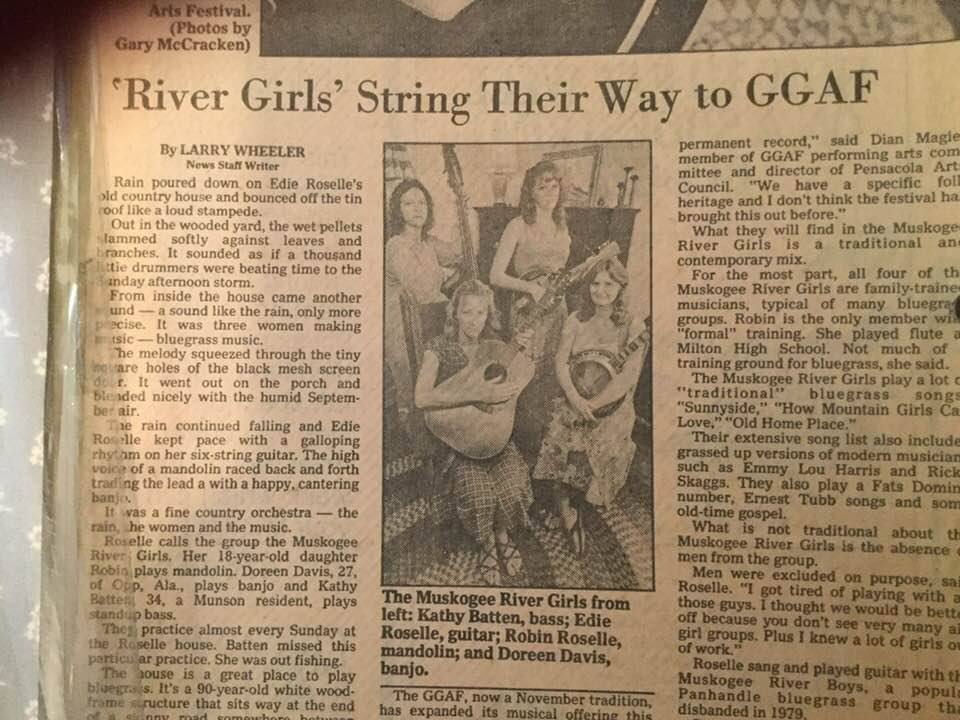
https://photos.app.goo.gl/96sgKtmNPLZKxWZW8
I was excited when I recalled seeing a picture of Witch Hazel in an archive of Akira Otsuka’s photos from the 1970s hosted on Fred Robbins’ website (which hosts a truly stunning amount of random information).

I had searched for more info on the group the first time I saw the photo with no luck but in looking through the collection again was delighted to see a photo of Sugar in the Gourd with the members labeled.

And this picture of Sharon and Mia from both bands jamming

source for all three: https://frobbi.org/akira/1977%20Carlton%20Haney%20Festivals/album/
Despite my efforts, these are the only references I can find to either of these bands or any of their members online. (Also, check out all of Akira’s work. He’s amazing and the fact that he not only captured so much history as it was happen but has also now gone back and put it online is incredible).
That leaves these six bands that I was unable to find any information about:
Mother-of-Pearl, Nashville
Local Tomatoes, D.C.
Out of the Blue, Colorado
Ladies of Bluegrass, Georgia
Sweet Dixie
Ladies Fancy
And more than a dozen that I only have very limited information for:
Muscogee River Girls, Florida
Ribbons & Straw, Nevada
Bar Belles, California
Witch Hazel, D.C.
Bushwhackers, Nashville
Dixie Reign, Virginia
Lonesome Doves, Washington State
Sassygrass, New England
Valley Dolls, Virginia
Bluegrass Liberation, North Carolina
Feminine Grass
Cherokee Rose, North Carolina
Sugar in the Gourd
Mountain Lace
If you know anything about any of them, please let me know! There’s a chance that Ladies Fancy is a misnomer of Ladies Choice, an all female band from Colorado featuring Patty Clayton but that could be a different band entirely. Small bands with the same names as songs (like Sweet Dixie), or places, or businesses, etc., are extremely difficult to find information on.
It is worth noting that so far my research has been a solitary task that I’ve used as an escape between playing shows and traveling. I’m sure a simple email to some of these folks would reveal a lot more information and hopefully I’ll soon muster the humanity necessary to have such conversations.